Ink, Paper, and Instinct: A Collector's Guide to Authenticating British First Editions at Home
For the serious bibliophile, few moments carry quite the same electricity as holding a volume that may — just may — be a genuine first edition from a celebrated British press. The spine is tight, the boards appropriately worn, and the title page bears a date that sets the pulse racing. But excitement, however warranted, is no substitute for rigorous authentication. The rare book market has always attracted those willing to exploit enthusiasm, and the sophistication of modern forgeries has only increased the premium placed on knowledge.
The encouraging news is that a considerable portion of preliminary authentication work can be conducted from your own study, using a combination of reference materials, basic tools, and a methodical approach informed by British publishing history. Professional appraisers — including several with whom Bloomsbury Book Auctions regularly consults — emphasise that collectors who arrive with well-documented preliminary findings make the specialist's work more efficient and the valuation process more transparent.
Begin with the Collation: What the Title Page Reveals
The title page is the book's identity document, and British publishers across different centuries followed distinct conventions that forgeries frequently misrepresent. For nineteenth-century volumes from houses such as Chapman and Hall or John Murray, examine whether the imprint line includes the publisher's address as it appeared at the time of the claimed first printing. Publishers relocated with some regularity, and a volume purporting to be an 1847 first edition bearing an address the publisher did not occupy until 1853 is immediately suspect.
The edition statement itself warrants careful scrutiny. British publishers were not always consistent in explicitly identifying first editions — many simply printed the date without qualification, reserving phrases such as "Second Edition" or "Revised and Corrected" for subsequent printings. The absence of an edition statement in an older British volume is therefore not unusual and should not, in isolation, raise concern. However, cross-referencing against established bibliographies — Sadleir's XIX Century Fiction, the English Short Title Catalogue, or publisher-specific references — will confirm whether the collation matches the known first-edition description.
The Evidence in the Paper
Paper is among the most reliable indicators of a book's age, and it rewards close examination. Prior to the introduction of wood-pulp paper in the latter half of the nineteenth century, British books were printed on rag-based stock — cotton and linen fibres that age with characteristic grace. When held to natural light, genuine period paper will often reveal a soft, irregular texture and a warm, slightly creamy tone rather than the stark whiteness associated with modern manufacture.
A jeweller's loupe — ideally ten-power magnification — is an indispensable study tool. Under magnification, the laid lines and chain lines of handmade or early machine-made paper become clearly visible, forming a grid-like pattern that is difficult to replicate convincingly in modern reproductions. Wood-pulp paper, by contrast, appears more uniform under magnification, and any claim of a pre-1860 printing on such stock should be treated with considerable scepticism.
Acidity is another useful indicator. Older rag-based paper tends to remain relatively stable over time, whereas wood-pulp paper acidifies and browns with age in a manner that experienced handlers learn to recognise. A book presented as an 1890s first edition with uniformly deep browning throughout — rather than the more selective toning typical of genuine period volumes — merits further investigation.
Binding Methods and What They Betray
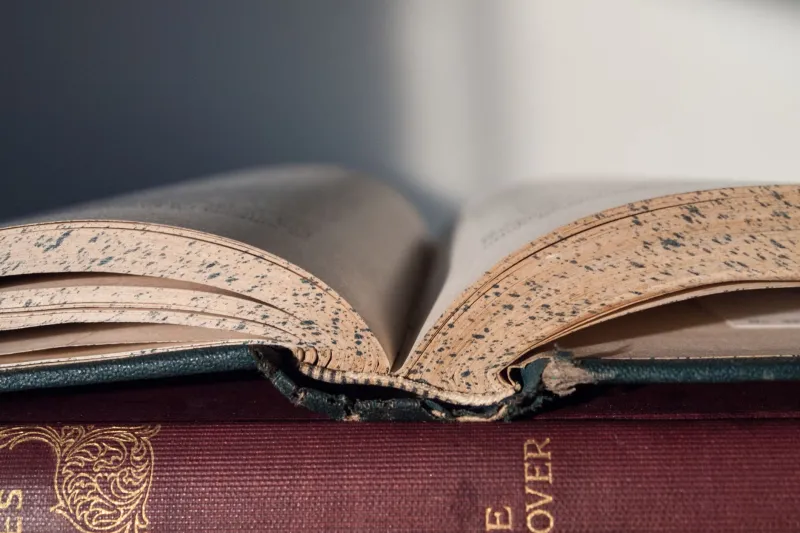
The binding of a British book tells its own story, and departures from period-appropriate methods are a significant red flag. Hand-sewn gatherings, visible in the gutter of older volumes when the book is carefully opened, characterise British bookbinding well into the Victorian era. The thread itself — its weight, the regularity of the stitching, and the adhesive used on the spine — all provide contextual evidence.
Machine-sewn bindings became increasingly common from the 1880s onward, and the distinction between hand and machine sewing is visible to a trained eye without specialist equipment. Similarly, the boards of a genuine period volume will typically show evidence of appropriate ageing along the hinges and corners. Artificially distressed bindings — a technique sometimes employed to lend false antiquity — tend to show wear in implausible patterns, concentrated at points that would not ordinarily receive the most handling.
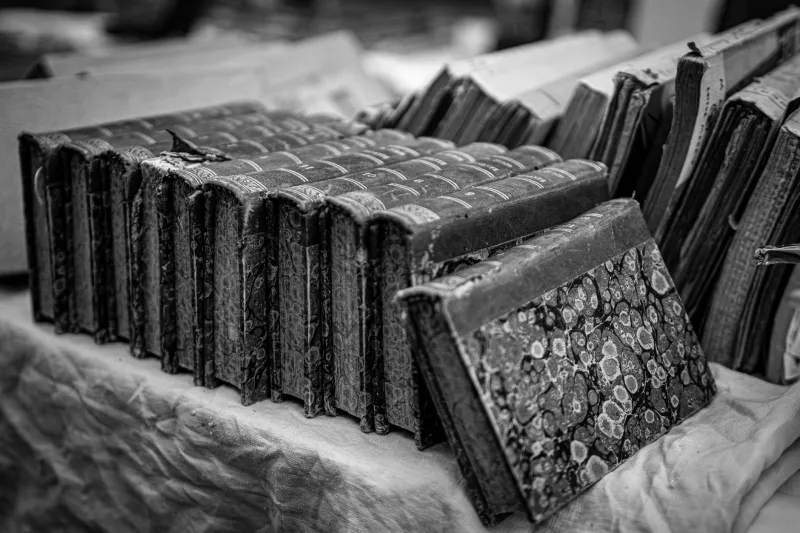
Cloth-bound Victorian novels present their own authentication considerations. The blocking — the decorative impression on the cover — was applied using brass dies under heat and pressure, producing a clarity and depth that later reproductions often fail to match precisely. Gilt blocking in particular tends to dull or flake in ways specific to the original adhesive compounds used, and a volume showing gilt in suspiciously pristine condition may warrant closer attention.
Typography as a Dating Tool
Typographic conventions evolved considerably across British publishing history, and familiarity with these changes is a powerful authentication resource. The long 's' — resembling a lower-case 'f' without the full crossbar — persisted in British printing until roughly the 1800s; its presence in a volume claimed to be later is anomalous, while its absence in an ostensibly eighteenth-century text is equally telling.
Typefaces themselves carry historical signatures. The move from old-style typefaces such as Caslon to the sharper, higher-contrast forms associated with Bodoni and Didot occurred in British printing during the late eighteenth and early nineteenth centuries. Specific publishers favoured particular compositors and typefaces across distinct periods, details documented in bibliographic scholarship that is increasingly accessible through university library catalogues and digitised trade journals.
Ink impression — the degree to which type has pressed into the paper surface — is also informative. Letterpress printing, which dominated British book production until well into the twentieth century, leaves a characteristic impression visible under raking light or magnification. Offset lithography, which gradually superseded letterpress, produces a flatter ink surface. A volume claiming an origin before offset lithography became standard, yet showing flat ink distribution, presents an immediate inconsistency.
Building Your Reference Library
No authentication process is complete without recourse to authoritative references, and the collector who invests in a working bibliographic library is considerably better equipped than one who relies on memory alone. Beyond the major bibliographies already mentioned, publisher histories — Murray's archive-based publications, the histories of Longmans, Macmillan, and Oxford University Press — provide invaluable context for imprint conventions and production methods.
Digital resources have expanded access considerably. The British Library's online catalogue, the English Short Title Catalogue, and WorldCat allow rapid cross-referencing of holdings and editions. Auction records, including those maintained by Bloomsbury Book Auctions, provide comparative data on how authenticated examples of specific titles have been described and valued.
When preliminary study raises as many questions as it answers, the appropriate course is professional consultation. The authentication techniques described here are precisely that — preliminary. They establish a framework for informed discussion with a specialist appraiser, not a substitute for expert examination. A book that survives rigorous home assessment and subsequently passes professional scrutiny is one that enters the auction room with its provenance clearly established — and that transparency, in our experience, is consistently reflected in the final hammer price.