The Anatomy of a Fine Copy: How Binding, Paper, and Print Quality Determine Auction Outcomes for British Books
Collectors new to the rare book market frequently arrive with the reasonable assumption that value follows rarity. If a book exists in few copies, it must be valuable; if it exists in many, less so. This logic is not without merit, but it is incomplete in ways that can prove costly. Experienced buyers at auction understand that rarity is merely one axis along which value is plotted. The other — equally important, and considerably more technical — is physical quality.
Two copies of the same first edition, printed in the same year by the same publisher, can attract hammer prices that differ by an order of magnitude. The explanation lies not in the words on the page but in the craft with which those pages were made, bound, and preserved. For collectors seeking to develop genuine expertise in the British rare book market, acquiring a working knowledge of binding traditions, paper manufacture, and printing standards across different periods is not optional. It is foundational.
Leatherwork and the Hierarchy of British Bindings
The binding is the first thing a prospective buyer sees, and in the auction room, first impressions carry financial weight. British bookbinding has a history of extraordinary sophistication, and the ability to distinguish a fine binding from a merely serviceable one is a skill that repays careful cultivation.
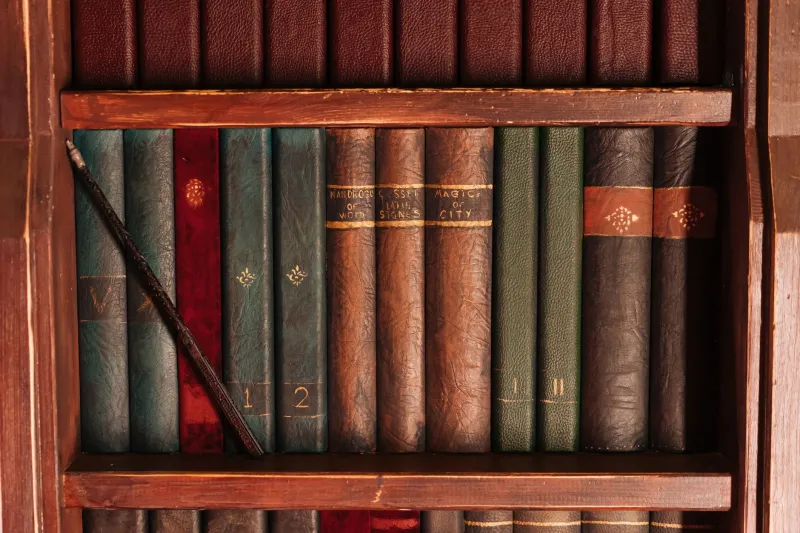
Hand-tooled leather bindings represent the apex of the craft. Produced by skilled finishers working with heated brass tools to impress decorative designs into the leather, these bindings are identifiable by the crispness of their impressions, the consistency of their gilding, and the quality of the leather itself. Full calf, morocco, and vellum each carry their own associations and market values, with fine morocco — particularly when decorated in period styles such as the elaborate pointillé work favoured in the seventeenth century or the restrained neoclassical designs of the late eighteenth — commanding the strongest premiums.
The distinction between a contemporary binding (one applied at or near the time of the book's publication) and a later rebind is crucial. A seventeenth-century text in its original binding, however worn, is generally preferable at auction to the same text rebound in the nineteenth century, however beautifully. Originality of binding speaks to the book's uninterrupted history; a rebind, however skilled, introduces a discontinuity that most serious collectors find commercially and aesthetically significant.
Collectors should also attend to the work of named British binderies. Firms such as Rivière, Zaehnsdorf, and Sangorski & Sutcliffe produced bindings of such distinction that their involvement constitutes its own form of provenance. A volume in a documented Sangorski binding is a different proposition from one in anonymous decorative leather of similar age.
Paper: Weight, Texture, and the Evidence of Quality
The paper on which a book is printed is among the most reliable indicators of its original production values — and, consequently, of its likely durability and desirability. In earlier periods of British publishing, paper quality varied considerably, and the finest editions were invariably printed on the finest stock.
Laid paper, produced by hand on wire moulds and identifiable by the parallel lines visible when the sheet is held to the light, was the standard for quality British printing from the medieval period through to the early nineteenth century. Within this category, distinctions of weight, texture, and whiteness are meaningful. Paper produced for prestige editions — subscription volumes, limited press runs, presentation copies — was typically heavier and more carefully prepared than that used for trade copies.
The introduction of wove paper in the latter part of the eighteenth century, and the subsequent industrialisation of paper manufacture in the nineteenth, created new hierarchies. For Victorian and Edwardian collectors, the relevant distinctions shifted towards the difference between machine-made paper and the handmade sheets retained by private presses such as the Kelmscott Press and the Doves Press. William Morris's insistence on handmade paper for Kelmscott publications was not aesthetic caprice; it was a deliberate statement of value that the auction market has consistently honoured.
Conversely, the acid content of cheaper wood-pulp papers introduced in the nineteenth century means that many Victorian books are in a state of advanced deterioration, their pages brittle and discoloured. A copy on better stock — or, in some cases, one of a small number printed on special paper for subscribers — will command a premium that reflects both its superior condition and its relative scarcity.
Printing Technique and Publisher Prestige
The method by which a book was printed, and the house responsible for its production, are further variables that experienced buyers assess with care. Hand-press printing, which remained standard in Britain until the early nineteenth century, produced impressions of a character that letterpress and later offset printing cannot replicate. The slight indentation of type into paper, the evenness of ink distribution, and the overall visual authority of a well-printed early book are qualities that collectors and scholars alike find compelling.
The prestige of the printing house matters independently of the printing method. The Clarendon Press at Oxford, the Cambridge University Press, and, in the private press tradition, the aforementioned Kelmscott and Doves enterprises, each produced work to standards that distinguished their output from contemporary commercial printing. A book bearing the imprint of one of these houses enters the auction room with a credential that affects its value before any other quality is assessed.
For collectors of twentieth-century material, the equivalent consideration is the small literary press. Early publications from the Hogarth Press — founded by Leonard and Virginia Woolf — carry a premium that reflects both their literary associations and the deliberate care with which the Woolfs approached their printing. The physical modesty of some early Hogarth productions, far from diminishing their value, enhances it: these are books made with intention, and intention is legible in the object.
Condition Grading and the Collector's Vocabulary
Developing fluency in the language of physical condition is indispensable for anyone participating in the auction market. Terms such as fine, very good, good, and fair carry specific meanings in the rare book trade, and the difference between a copy described as fine and one described as good can represent a substantial financial gap.
Beyond standard condition grading, collectors should attend to specific physical features: the integrity of hinges and joints, the presence or absence of foxing (those rust-coloured spots caused by mould or metallic impurities in the paper), the condition of any gilt decoration on the spine, and whether the binding retains its original endpapers. Each of these details contributes to a cumulative assessment that experienced buyers make rapidly and largely intuitively — though the intuition is, in every case, the product of sustained attention to physical objects over time.
The auction room ultimately rewards those who have done the work of understanding what they are looking at. A collector who can assess the quality of a hand-tooled binding, identify the paper type of an eighteenth-century volume, and recognise the imprint of a distinguished printing house is not simply better informed than their less-prepared counterpart. They are, in the most practical sense, better positioned to find value where others see only an old book.